
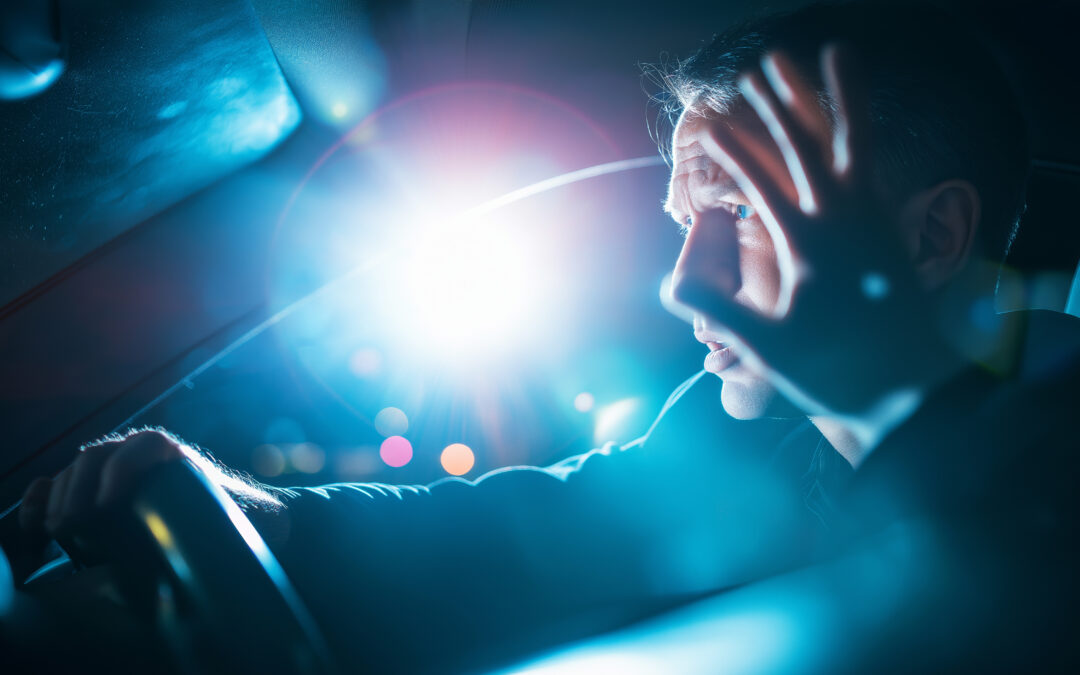
In complex auto accident litigation, the most heavily disputed element of a case often comes down to a single, critical question: What could the driver actually see?
When an accident occurs in low-light conditions—whether it involves a pedestrian crossing a poorly lit street, a disabled vehicle stalled in a dark traffic lane, or a commercial truck blending into the night sky—liability hinges on visibility. The plaintiff’s counsel will argue that the hazard was obvious and the driver was inattentive. The defense will counter that the hazard was virtually invisible until it was too late to initiate evasive action.
Relying on “he said, she said” testimony or standard police scene photographs is a tremendous risk when millions of dollars are on the line. Juries struggle to conceptualize abstract physics equations or human factors data regarding perception-reaction times in the dark. They need to see the scene exactly as the driver saw it.
To bridge this gap between complex engineering data and jury comprehension, top-tier trial attorneys turn to a nighttime visibility expert witness. By combining accepted engineering measurement procedures with photorealistic high-definition video, a qualified expert provides foundationally sound, indisputable visual evidence that can make or break your case.
Facing a complex low-light auto accident case? Don’t let the opposition control the narrative with inaccurate photos or computer cartoons. Contact Paul Kayfetz Inc. today to discuss your case strategy with a team that has conducted over 1,800 nighttime visibility studies.
The Fatal Flaws of Standard Evidence in Nighttime Crashes
Why is a specialized expert necessary? Because standard methods of capturing a nighttime accident scene fail to accurately represent human vision, frequently resulting in misleading evidence that can severely damage your case.
1. The Trap of Police and Cell Phone Photography
When law enforcement arrives at an accident scene, their primary goal is documentation, not human vision replication. Police photographs are almost always taken with high-powered flash units. A flash violently illuminates the scene, revealing details, pedestrians, or unlit vehicles that were completely swallowed by darkness just moments before the crash.
Similarly, modern smartphones use aggressive computational photography. When a witness snaps a photo with an iPhone or Android device, the camera’s software automatically opens the aperture, extends the exposure time, and digitally brightens the image. The result makes a pitch-black rural highway look like it is bathed in twilight. If these images are presented to a jury without proper context, the jury will wrongfully assume the driver had ample lighting to see the hazard.
2. The Problem with “Computer Cartoons”
To counter misleading photographs, some legal teams invest heavily in computer animations. However, these are often perceived by judges and juries as subjective “computer cartoons.” Because they are built entirely from scratch in a digital environment, opposing counsel can easily attack them on cross-examination. They will argue that the animator artificially manipulated the lighting, contrast, and texture to favor their client’s narrative. An animation is only an illustration of an expert’s opinion; it is not a photographic record of reality.
3. The Human Eye vs. The Camera Lens
The human eye is an incredibly complex optical instrument with a specific dynamic range. It processes glare from oncoming headlights, struggles with low-contrast objects (such as a pedestrian in dark clothing against dark asphalt), and requires time to dark-adapt. Standard cameras do not replicate these physiological nuances. To accurately capture these conditions, you need the specialized techniques of engineering photography.
What Does a Nighttime Visibility Expert Witness Actually Do?
A nighttime visibility expert witness does not just take pictures in the dark. They engage in a meticulous scientific process known as engineering photography—the integration of photographic and optical techniques with strict engineering measurement procedures.
At Paul Kayfetz Inc., our methodology has been refined over fifty years and through more than 5,000 driver’s eye visibility studies, including some 1,800 conducted specifically at night.
Video Enhancement: Unlocking Hidden Details in Dash Cams and Security Footage
Beyond producing original HD visibility studies, a critical service provided by a technical expert is the enhancement of existing video evidence. Today, auto accidents are frequently captured by dash cameras, police body cameras, and nearby security surveillance systems. However, this raw footage is often grainy, low-resolution, or poorly lit, making it difficult to discern crucial details.
Through advanced computer engineering techniques, we specialize in finding hidden details within these recordings. By carefully stabilizing shaky footage, reducing digital noise, and sharpening essential details, an engineering photography expert can make blurry or dark video usable. This enhanced video can reveal critical information that the driver or other witnesses might have missed, providing an indispensable advantage during litigation.
Recreating the Exact Environmental Conditions
To ensure the resulting HD video is both accurate and admissible, the expert must recreate the exact conditions present at the time of the collision. This involves rigorous planning and coordination:
- Lunar Illumination: The study must be conducted on a night when the moon phase and position in the sky match the night of the incident.
- Weather and Atmospheric Conditions: Factors like ambient moisture, fog, or clear skies heavily dictate light scatter and must be replicated.
- Vehicle Headlight Geometry: The expert must use an exemplar vehicle with the same make, model, and headlight casing. The headlights must be properly aimed and measured to ensure their photometric output (reach and spread) matches the involved vehicle.
- Glare Introduction: If oncoming traffic was a factor, the study must accurately introduce the blinding effect of opposing headlights to show how it degraded the subject driver’s forward visibility.
Capturing Photorealistic HD Video
Once the scene is meticulously staged, the nighttime visibility expert witness uses specialized, high-definition video systems calibrated to replicate the exact light-gathering capability, contrast sensitivity, and visual acuity of the human eye.
The result is movie-theater-quality HD video that places the jury directly in the driver’s seat. They experience the approach to the point of impact in real-time. They see exactly when a hazard emerges from the darkness and becomes perceptible. You can view examples of this powerful demonstrative evidence in our HD Video Samples.
The Strategic Advantage in Litigation
Bringing a nighttime visibility expert witness onto your trial team provides several distinct tactical advantages throughout the lifecycle of a case, from early settlement negotiations to the final closing argument.
1. Synergizing with Accident Reconstructionists
Visibility experts do not work in a vacuum. We frequently help plan complete technical testing strategies, coordinating with the top accident reconstructionists and human factors psychologists independently retained by counsel. While an accident reconstructionist calculates speed, delta-V, and braking distances, and a human factors expert testifies about perception-reaction times, the visibility expert provides the vital visual foundation that proves when the reaction time clock actually started ticking.
2. Keeping Opposing Evidence Out of Court
A major, often overlooked part of our work is evaluating the opposition’s forensic photography and computer simulations. Because Mr. Kayfetz is a former attorney and deeply understands the rules of evidence, our team excels at tearing down opposing exhibits.
If the opposing expert failed to calibrate their camera to the human eye, used incorrect headlight aiming, or relied on animation software that incorrectly renders nighttime contrast, we expose those foundational flaws. Keeping the opponent’s misleading work out of evidence has swung multi-million dollar results several times in recent years, including a notable $62 Million Verdict.
3. Driving Powerful Settlements
When opposing counsel is confronted with an unimpeachable, foundationally sound HD video that clearly exonerates a defendant (or conclusively proves a plaintiff’s claim), their willingness to risk a jury trial plummets. In many cases, simply producing a Kayfetz visibility study during mediation or discovery is enough to force a highly favorable, multi-million dollar settlement without ever stepping foot in a courtroom.
The Ultimate Hurdle: Courtroom Admissibility
The most visually stunning video in the world is entirely worthless to your case if the judge excludes it from evidence. The rules governing the admissibility of demonstrative evidence and expert testimony (whether under Frye, Daubert, or state-specific standards) are stringent, particularly when dealing with recreated nighttime conditions.
Courts are naturally skeptical of recreated visual evidence, fearing it might prejudice the jury if it is not a “fair and accurate” representation of the original event. This is where the pedigree of your expert matters most.
Establishing the Proper Legal Foundation
To get a nighttime visibility study admitted, the expert must lay a flawless technical foundation. They must be prepared to testify extensively about their methodology, the calibration of their equipment, and the peer-reviewed science backing their procedures.
Paul Kayfetz Inc. has published numerous peer-reviewed engineering papers on visibility study methodology and the proper technical foundation required to facilitate admissibility. Furthermore, our computer engineers, video engineers, and engineering photography experts apply accepted, verifiable measurement procedures to everything we produce.
A Record of Unmatched Success
When you retain Paul Kayfetz Inc., you are hiring a firm with an unparalleled track record in the courtroom. Mr. Kayfetz has been qualified as an expert witness more than 500 times since 1963 in Federal and State Courts across Hawaii, Alaska, Washington, Oregon, California, Nevada, Arizona, Colorado, Oklahoma, Texas, Missouri, Florida, Alabama, Washington, D.C., and Pennsylvania.
Most importantly: He has never been denied qualification.
Judges recognize and respect the scientific rigor of our work, allowing our HD visibility studies to be routinely admitted into evidence year after year.
Case Study: The Difference Real Visibility Makes
Consider a common scenario: A commercial truck driver strikes a pedestrian wearing dark clothing on an unlit highway at 2:00 AM.
The plaintiff’s attorney presents a police photograph taken with a flash, showing the pedestrian clearly visible against the asphalt. They argue the trucker was distracted.
The defense team retains a nighttime visibility expert witness from Paul Kayfetz Inc. We evaluate the scene, calculate the ambient lighting, secure a truck with matching headlights, and shoot an HD video approach on a night with matching lunar illumination.
The resulting video is played for the jury. Instead of the brightly lit police photo, the jury looks through the windshield of the truck in real-time. They see the blinding glare of oncoming traffic. They see the reach of the low-beam headlights. And they see that due to the low contrast of the clothing against the road surface, the pedestrian was entirely invisible until the truck was less than 50 feet away—making the accident tragically unavoidable given the vehicle’s speed and standard human reaction times.
The jury isn’t forced to guess who is right; they have experienced the reality of the driver’s perspective for themselves.
Conclusion
In low-light accident litigation, the jury’s verdict depends entirely on their understanding of the driver’s visual reality. Relying on standard photographs or untested computer animations is a gamble you cannot afford to take.
By utilizing accepted engineering measurement procedures and photorealistic high-definition video, a specialized expert cuts through the technical jargon and provides clear, unassailable proof. For fifty years, Paul Kayfetz Inc. has helped attorneys win and save hundreds of millions of dollars by answering the most critical question in auto litigation: What could the driver actually see?
Ready to build an unassailable visual foundation for your next trial? Review our Fee Schedule and explore our Curriculum Vitae to see why top litigators across the country trust Paul Kayfetz Inc.
Contact Us Today to schedule a consultation and ensure the jury sees the truth of your nighttime auto case.
Recent Comments